> ## Documentation Index
> Fetch the complete documentation index at: https://www.adaline.ai/docs/llms.txt
> Use this file to discover all available pages before exploring further.
# Setup continuous evaluations
> Score production spans with evaluators and watch quality in Monitor
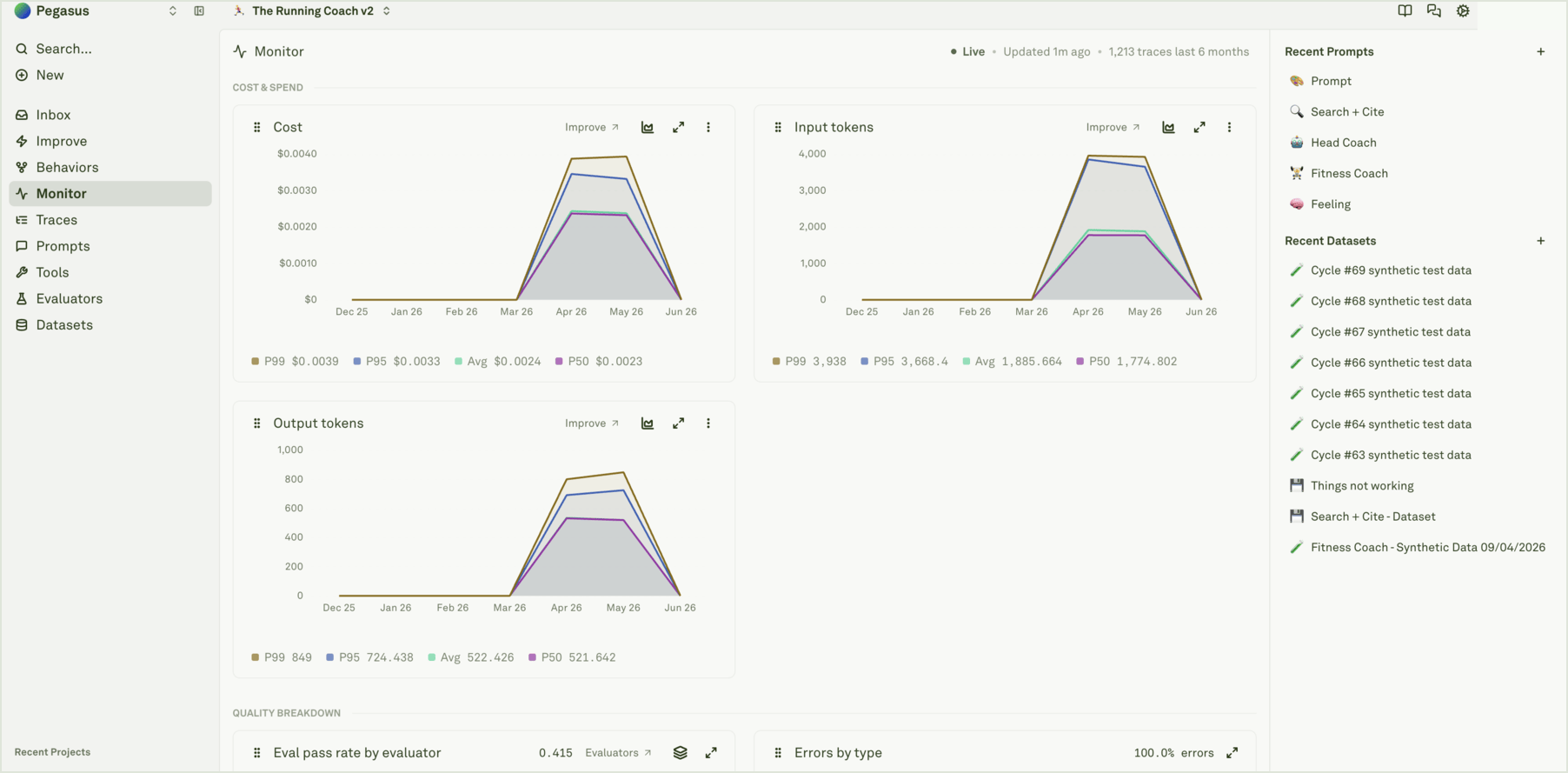
Continuous evaluations run evaluators on production model spans so quality appears beside runtime metrics. Use them when you want Monitor to show not only whether the agent answered, but whether the answer met your criteria.
## How it works
1. A prompt is deployed and receiving logged model spans.
2. Evaluators are attached to the prompt or evaluation workflow.
3. Adaline scores sampled production spans.
4. Results appear in span details and Monitor charts.
5. Failing or important spans can become dataset rows, Behavior evidence, or Improve context.
 ## What to monitor
| Signal | What it means |
| ------------------------------- | ------------------------------------------------------- |
| **Average eval score** | Overall quality trend for evaluated production traffic. |
| **Eval pass rate by evaluator** | Which quality dimensions are passing or failing. |
| **Errors by type** | Where failures are concentrated. |
| **Span evaluation tab** | The exact score and reason for one model span. |
If quality drops, open the traces behind the chart before changing the prompt. The failure could be a prompt issue, missing retrieval context, tool behavior, evaluator criteria, or bad instrumentation.
## Good evaluator coverage
Use continuous evaluations for checks that are meaningful on live traffic:
* Safety or policy compliance.
* Format or schema correctness.
* Tool-use correctness.
* Domain-specific answer quality.
* Cost, latency, or response length thresholds.
* Regression checks from important dataset rows.
For evaluator setup and types, see [Evaluators overview](/docs/evaluators/overview).
## Use results in the improvement loop
When a production span fails an evaluator:
1. Open the trace and read the model span, tool context, and evaluator reason.
2. Add the span to a dataset if it should become regression coverage.
3. Update the evaluator if the score is wrong or too broad.
4. Start or review an Improve cycle when the fix belongs in the prompt.
5. Watch the eval score chart after release.
Run evaluation checks across prompts and datasets.
Understand production scoring and pre-release checks.
Read evaluator results on a selected span.
Turn failing production evidence into improvements.
## What to monitor
| Signal | What it means |
| ------------------------------- | ------------------------------------------------------- |
| **Average eval score** | Overall quality trend for evaluated production traffic. |
| **Eval pass rate by evaluator** | Which quality dimensions are passing or failing. |
| **Errors by type** | Where failures are concentrated. |
| **Span evaluation tab** | The exact score and reason for one model span. |
If quality drops, open the traces behind the chart before changing the prompt. The failure could be a prompt issue, missing retrieval context, tool behavior, evaluator criteria, or bad instrumentation.
## Good evaluator coverage
Use continuous evaluations for checks that are meaningful on live traffic:
* Safety or policy compliance.
* Format or schema correctness.
* Tool-use correctness.
* Domain-specific answer quality.
* Cost, latency, or response length thresholds.
* Regression checks from important dataset rows.
For evaluator setup and types, see [Evaluators overview](/docs/evaluators/overview).
## Use results in the improvement loop
When a production span fails an evaluator:
1. Open the trace and read the model span, tool context, and evaluator reason.
2. Add the span to a dataset if it should become regression coverage.
3. Update the evaluator if the score is wrong or too broad.
4. Start or review an Improve cycle when the fix belongs in the prompt.
5. Watch the eval score chart after release.
Run evaluation checks across prompts and datasets.
Understand production scoring and pre-release checks.
Read evaluator results on a selected span.
Turn failing production evidence into improvements.