> ## Documentation Index
> Fetch the complete documentation index at: https://www.adaline.ai/docs/llms.txt
> Use this file to discover all available pages before exploring further.
# Overview
> Define criteria that score prompts, logs, datasets, continuous evaluation, and Improve candidates
Evaluators define what good output means for a prompt. They score model responses during prompt evaluations, production monitoring, log review, and Improve cycles.
Use Evaluators when a product rule, quality bar, safety requirement, format contract, cost budget, latency target, or production failure should become a repeatable check.
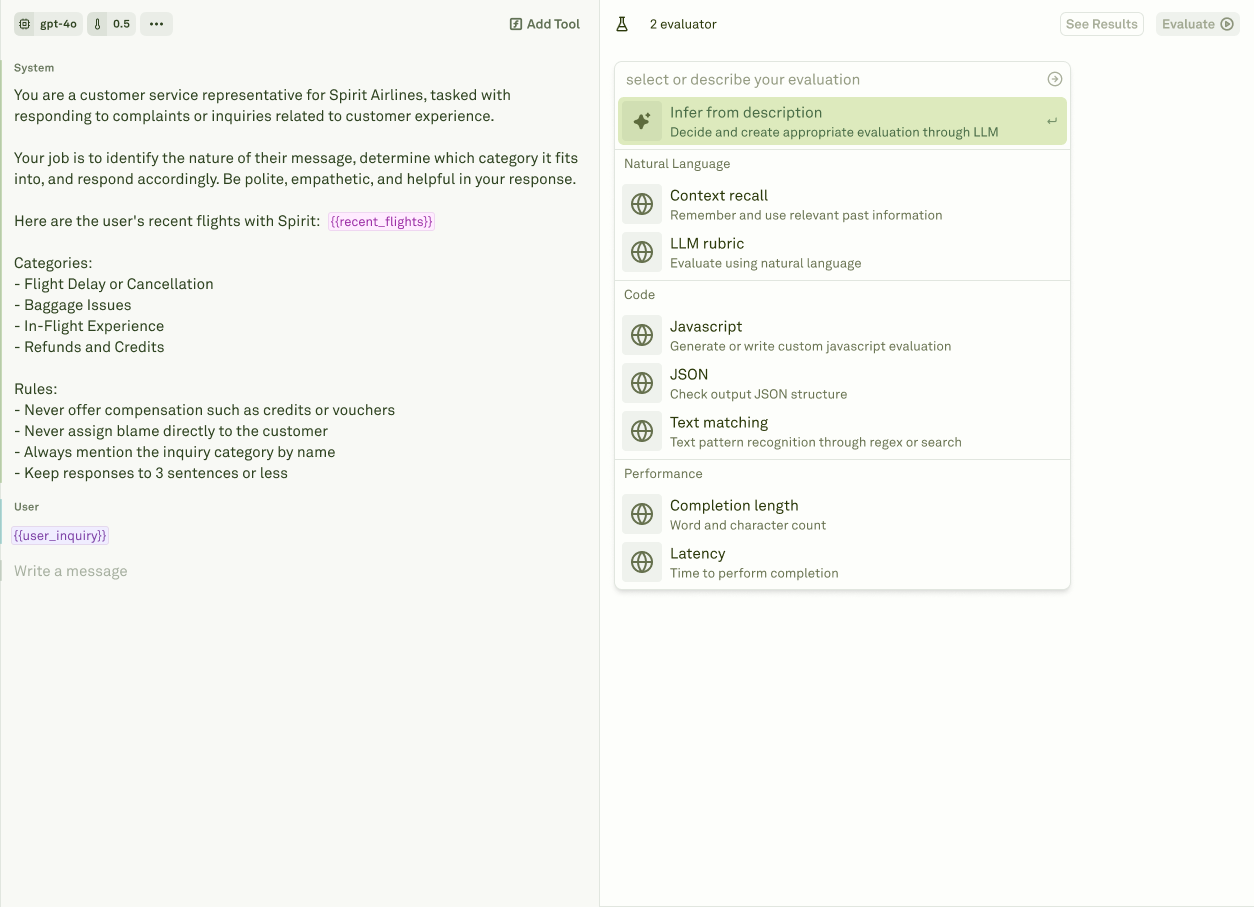 ## Evaluation anatomy
Every useful evaluation has five parts:
| Part | Meaning | Question it answers |
| ------------------ | ---------------------------------------------------------------------- | ------------------------------------------- |
| **Data** | Dataset rows, production spans, generated cases, or Improve examples. | Which customer situations are being tested? |
| **Task or prompt** | Prompt version, model settings, variables, tools, and response schema. | What behavior would the user experience? |
| **Evaluator** | Criterion used to score the response. | What does the team mean by good enough? |
| **Result** | Score, pass/fail, reason, cost, latency, or custom output. | Did it pass for the right reason? |
| **Action** | Approve, reject, edit, add coverage, Improve, deploy, or roll back. | What changes because of this result? |
If an evaluator result does not lead to a decision, it is still evidence, but it is not yet an operational quality gate.
## Evaluator types
| Evaluator | Use it for |
| ------------------- | ---------------------------------------------------------------------------- |
| **LLM-as-a-Judge** | Rubric-based quality, safety, policy, tone, and reasoning checks. |
| **Custom Prompt** | LLM-based evaluation with custom model configuration and prompt logic. |
| **JavaScript** | Deterministic checks, schema validation, custom scoring, and business rules. |
| **JSON** | Structured JSON checks and schema-like assertions. |
| **API Call** | External service checks through your own evaluator endpoint. |
| **Text Matcher** | Required or forbidden strings, regexes, and formatting markers. |
| **Cost** | Budget thresholds based on provider cost. |
| **Latency** | SLA thresholds based on runtime. |
| **Response Length** | Word, token, character, or brevity requirements. |
Prefer deterministic evaluators for exact rules. Use LLM-based evaluators when the criterion requires judgment, then calibrate them with known passing and failing examples.
## Where evaluators run
## Evaluation anatomy
Every useful evaluation has five parts:
| Part | Meaning | Question it answers |
| ------------------ | ---------------------------------------------------------------------- | ------------------------------------------- |
| **Data** | Dataset rows, production spans, generated cases, or Improve examples. | Which customer situations are being tested? |
| **Task or prompt** | Prompt version, model settings, variables, tools, and response schema. | What behavior would the user experience? |
| **Evaluator** | Criterion used to score the response. | What does the team mean by good enough? |
| **Result** | Score, pass/fail, reason, cost, latency, or custom output. | Did it pass for the right reason? |
| **Action** | Approve, reject, edit, add coverage, Improve, deploy, or roll back. | What changes because of this result? |
If an evaluator result does not lead to a decision, it is still evidence, but it is not yet an operational quality gate.
## Evaluator types
| Evaluator | Use it for |
| ------------------- | ---------------------------------------------------------------------------- |
| **LLM-as-a-Judge** | Rubric-based quality, safety, policy, tone, and reasoning checks. |
| **Custom Prompt** | LLM-based evaluation with custom model configuration and prompt logic. |
| **JavaScript** | Deterministic checks, schema validation, custom scoring, and business rules. |
| **JSON** | Structured JSON checks and schema-like assertions. |
| **API Call** | External service checks through your own evaluator endpoint. |
| **Text Matcher** | Required or forbidden strings, regexes, and formatting markers. |
| **Cost** | Budget thresholds based on provider cost. |
| **Latency** | SLA thresholds based on runtime. |
| **Response Length** | Word, token, character, or brevity requirements. |
Prefer deterministic evaluators for exact rules. Use LLM-based evaluators when the criterion requires judgment, then calibrate them with known passing and failing examples.
## Where evaluators run
 | Workflow | What evaluators do |
| ---------------------- | --------------------------------------------------------------------- |
| **Prompt evaluations** | Run against datasets before release or during prompt development. |
| **Monitor and Logs** | Score sampled production traffic for continuous quality signals. |
| **Improve** | Reject candidates that improve one behavior while regressing another. |
Draft evaluators created during an Improve cycle should be reviewed before they become trusted release gates.
## Online and offline evaluation
| Mode | Use it for | Source |
| ---------------------- | ----------------------------------------------------------------------------------------------------- | ---------------------------------------------------------------------------------- |
| **Offline evaluation** | Pre-release checks, prompt comparison, regression testing, Improve candidate review, and CI/CD gates. | Curated datasets, golden examples, and production failures promoted into datasets. |
| **Online evaluation** | Continuous monitoring, silent failure detection, release watch, and drift investigation. | Production logs and spans with useful metadata. |
The strongest loop is: online failure -> log evidence -> dataset row -> evaluator -> offline release gate -> deployment -> online watch.
## Create useful evaluators
Use a Behavior, failing log, customer report, or product requirement to define what should pass or fail.
Use deterministic evaluators for exact rules and LLM-as-a-Judge for qualitative criteria.
Link the evaluator where it should run so evaluations and Improve cycles can use it.
Run it against known passing and failing cases before relying on it for approval decisions.
## Coverage checklist
For important prompts, cover the risks customers would notice:
| Risk | Coverage example |
| ---------------------- | ------------------------------------------------------------------ |
| **Correctness** | LLM-as-a-Judge rubric, JavaScript business rule, or API evaluator. |
| **Safety and policy** | LLM-as-a-Judge rubric with explicit passing and failing examples. |
| **Structure** | JSON, JavaScript, or Text Matcher evaluator. |
| **Tool behavior** | Dataset rows requiring tool use plus output checks. |
| **Latency** | Latency evaluator for response-time budgets. |
| **Cost and verbosity** | Cost and Response Length evaluators. |
| **Known regressions** | Dataset rows created from production logs or Behaviors. |
Coverage does not need to be large to be useful. A small dataset with clear evaluators beats a large dataset with vague scoring.
Choose the right evaluator for quality, schema, cost, latency, and custom rules.
Connect curated datasets, production scoring, release gates, and Improve.
Turn product requirements and production failures into repeatable checks.
Run prompt evaluations against datasets and review results.
Store the cases evaluators should score.
| Workflow | What evaluators do |
| ---------------------- | --------------------------------------------------------------------- |
| **Prompt evaluations** | Run against datasets before release or during prompt development. |
| **Monitor and Logs** | Score sampled production traffic for continuous quality signals. |
| **Improve** | Reject candidates that improve one behavior while regressing another. |
Draft evaluators created during an Improve cycle should be reviewed before they become trusted release gates.
## Online and offline evaluation
| Mode | Use it for | Source |
| ---------------------- | ----------------------------------------------------------------------------------------------------- | ---------------------------------------------------------------------------------- |
| **Offline evaluation** | Pre-release checks, prompt comparison, regression testing, Improve candidate review, and CI/CD gates. | Curated datasets, golden examples, and production failures promoted into datasets. |
| **Online evaluation** | Continuous monitoring, silent failure detection, release watch, and drift investigation. | Production logs and spans with useful metadata. |
The strongest loop is: online failure -> log evidence -> dataset row -> evaluator -> offline release gate -> deployment -> online watch.
## Create useful evaluators
Use a Behavior, failing log, customer report, or product requirement to define what should pass or fail.
Use deterministic evaluators for exact rules and LLM-as-a-Judge for qualitative criteria.
Link the evaluator where it should run so evaluations and Improve cycles can use it.
Run it against known passing and failing cases before relying on it for approval decisions.
## Coverage checklist
For important prompts, cover the risks customers would notice:
| Risk | Coverage example |
| ---------------------- | ------------------------------------------------------------------ |
| **Correctness** | LLM-as-a-Judge rubric, JavaScript business rule, or API evaluator. |
| **Safety and policy** | LLM-as-a-Judge rubric with explicit passing and failing examples. |
| **Structure** | JSON, JavaScript, or Text Matcher evaluator. |
| **Tool behavior** | Dataset rows requiring tool use plus output checks. |
| **Latency** | Latency evaluator for response-time budgets. |
| **Cost and verbosity** | Cost and Response Length evaluators. |
| **Known regressions** | Dataset rows created from production logs or Behaviors. |
Coverage does not need to be large to be useful. A small dataset with clear evaluators beats a large dataset with vague scoring.
Choose the right evaluator for quality, schema, cost, latency, and custom rules.
Connect curated datasets, production scoring, release gates, and Improve.
Turn product requirements and production failures into repeatable checks.
Run prompt evaluations against datasets and review results.
Store the cases evaluators should score.