> ## Documentation Index
> Fetch the complete documentation index at: https://www.adaline.ai/docs/llms.txt
> Use this file to discover all available pages before exploring further.
# Trajectories
> Read the journey evidence behind coding-agent and multi-step Behaviors
Trajectories help explain how a Behavior happened across a task or journey. Use them when the issue is not contained in one model call or span: the agent planned, searched, edited, called tools, retried, recovered, tested, handed off, or failed somewhere along the way.
For most Behavior review, start with the catalog and detail page. Open trajectories when you need the larger story behind a repeated pattern. You can also reach the same journey view from **Traces** by switching to the **Sessions** tab.
## Start from Behavior detail
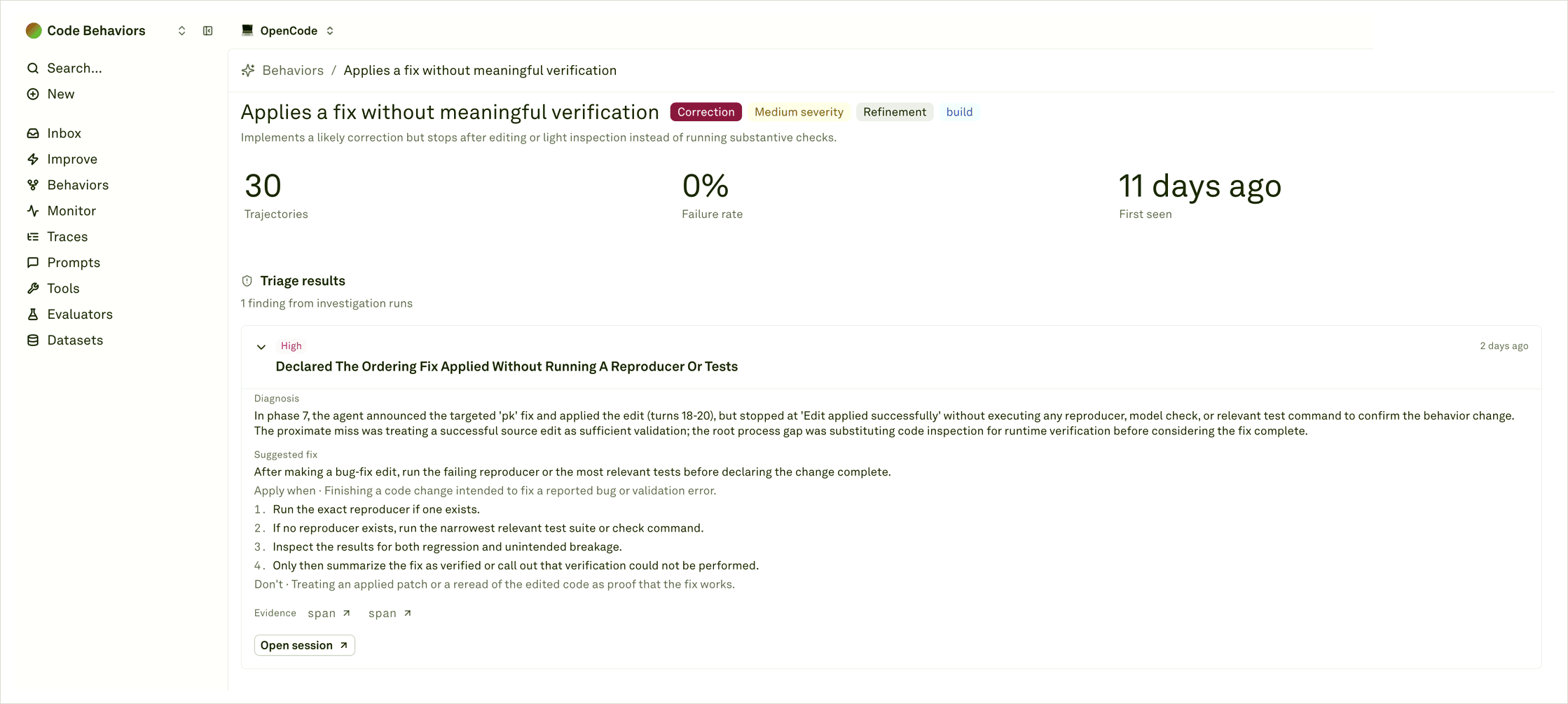 The Behavior detail page gives you the summary, tags, represented evidence, triage findings, and links back to source evidence. Triage is the first thing to read: it explains what Adaline thinks happened and why the pattern may matter.
Use the evidence links to inspect exact spans. Use **Open session** when you need to understand the task or journey around those spans.
## Open Sessions
The Behavior detail page gives you the summary, tags, represented evidence, triage findings, and links back to source evidence. Triage is the first thing to read: it explains what Adaline thinks happened and why the pattern may matter.
Use the evidence links to inspect exact spans. Use **Open session** when you need to understand the task or journey around those spans.
## Open Sessions
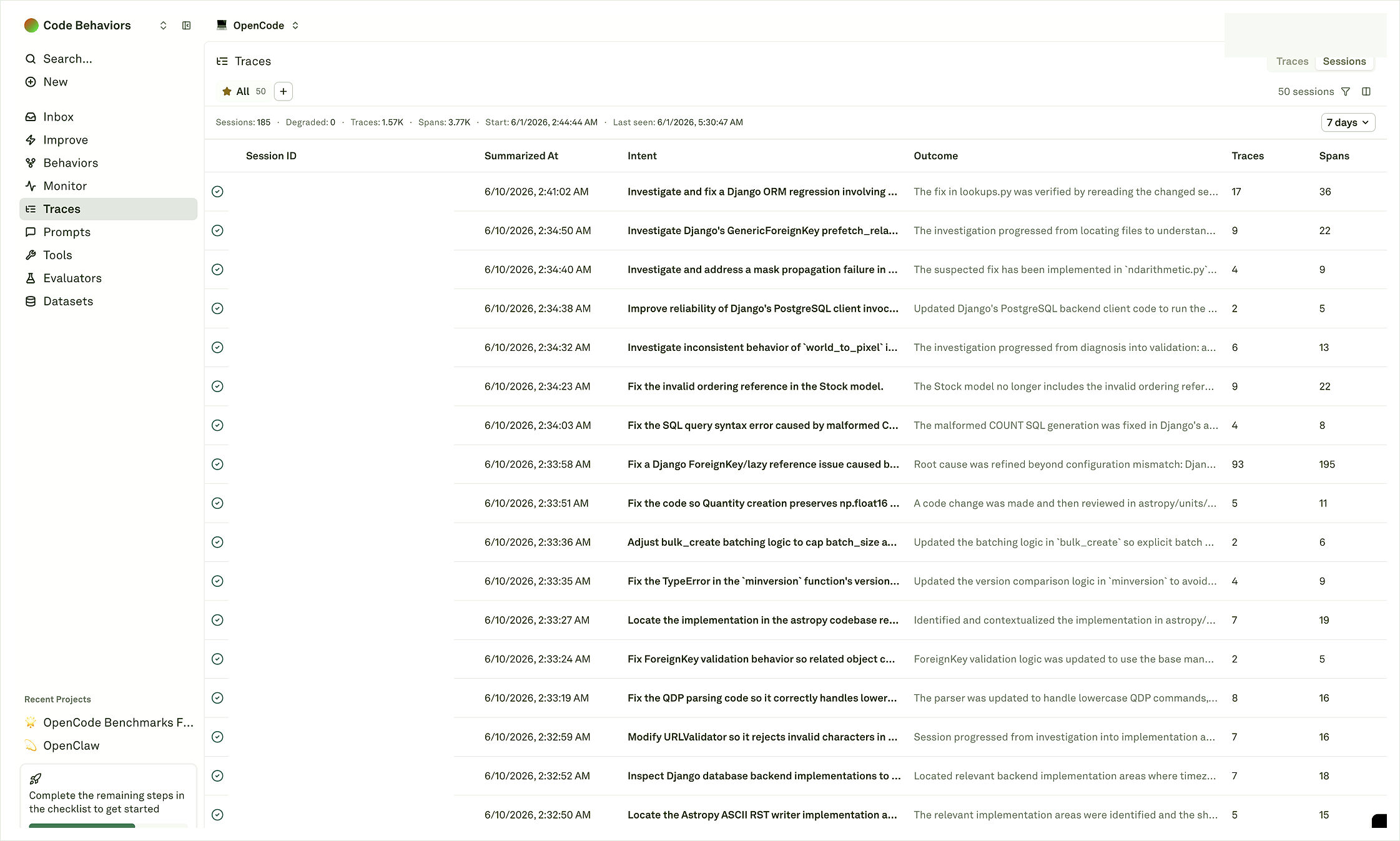 The **Sessions** tab groups related traces and spans into task journeys. For coding-agent projects, each row usually represents one agent task or benchmark run. The table shows the summarized intent, outcome, trace count, and span count so you can choose a journey that has enough evidence to inspect.
Use this view when you are starting from logs instead of a Behavior. Use the Behavior detail page when you want trajectories that contributed to a specific recurring pattern.
Read the table from left to right:
| Column | How to use it |
| ------------------ | --------------------------------------------------------------------------------------- |
| **Summarized at** | Check whether the session summary is fresh enough for the investigation. |
| **Intent** | Understand the task the agent was trying to complete. |
| **Outcome** | Compare what the agent claims happened with the source spans after opening the session. |
| **Traces / Spans** | Estimate how much evidence exists before you inspect the journey. |
## Read the journey summary
The **Sessions** tab groups related traces and spans into task journeys. For coding-agent projects, each row usually represents one agent task or benchmark run. The table shows the summarized intent, outcome, trace count, and span count so you can choose a journey that has enough evidence to inspect.
Use this view when you are starting from logs instead of a Behavior. Use the Behavior detail page when you want trajectories that contributed to a specific recurring pattern.
Read the table from left to right:
| Column | How to use it |
| ------------------ | --------------------------------------------------------------------------------------- |
| **Summarized at** | Check whether the session summary is fresh enough for the investigation. |
| **Intent** | Understand the task the agent was trying to complete. |
| **Outcome** | Compare what the agent claims happened with the source spans after opening the session. |
| **Traces / Spans** | Estimate how much evidence exists before you inspect the journey. |
## Read the journey summary
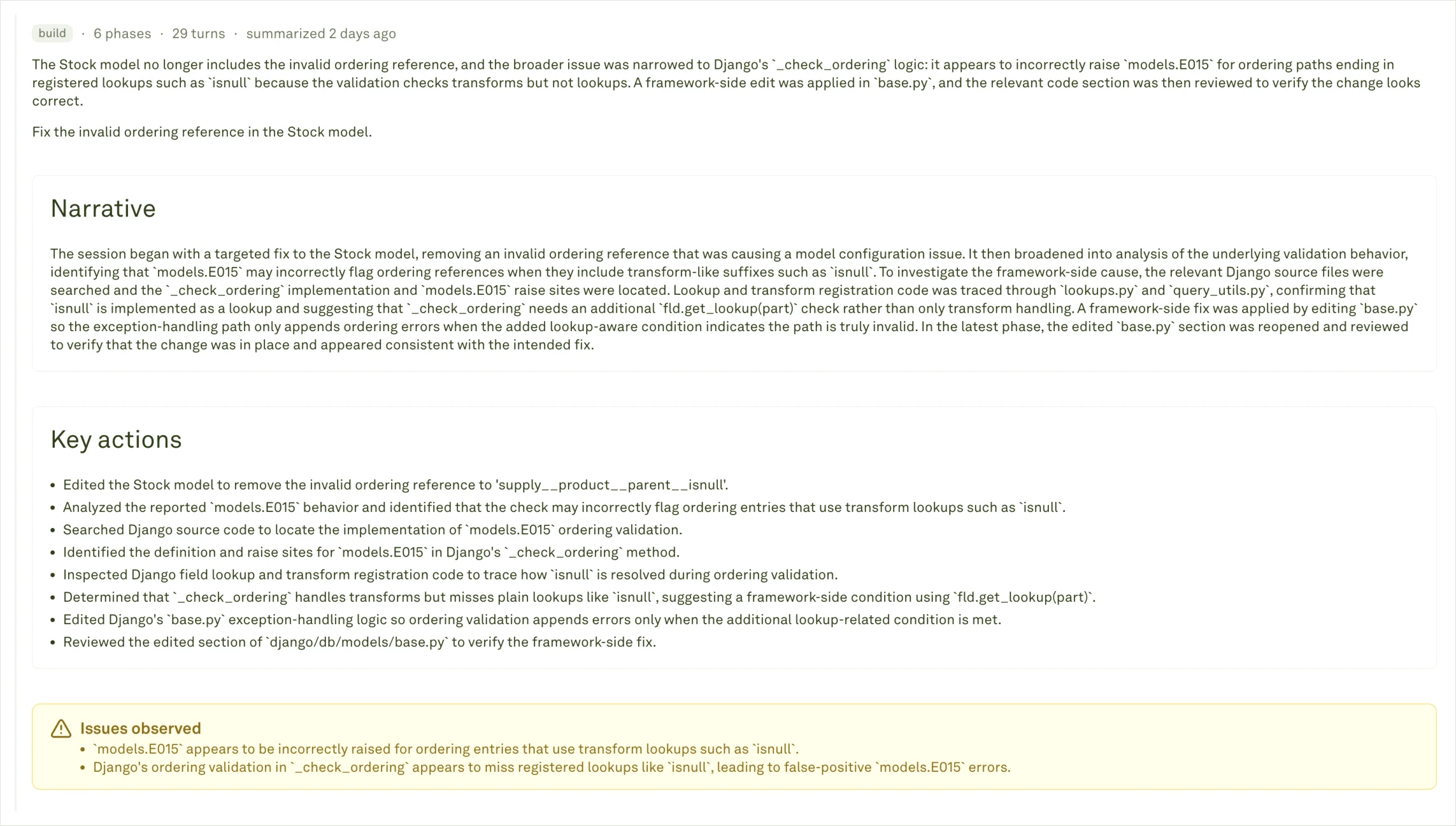 An opened session summarizes the task in a way that one trace cannot. Start with the status, phase count, turn count, narrative, key actions, and issues observed. This tells you what the agent attempted, whether it reached a usable outcome, and which parts of the journey deserve source-level inspection.
The summary is not a replacement for source evidence. It is a map. Use the narrative to understand the overall arc, the key actions to find important decisions, and the issues observed to decide where to inspect spans.
Use the summary to answer questions that a single span cannot answer:
* Did the agent recover after the first failure?
* Did it run a meaningful verification step before finishing?
* Did it keep searching or editing without converging?
* Did the final summary match the inspected evidence?
* Is the pattern repeated across several tasks, or is it one unusual run?
## Read a trajectory as phases
An opened session summarizes the task in a way that one trace cannot. Start with the status, phase count, turn count, narrative, key actions, and issues observed. This tells you what the agent attempted, whether it reached a usable outcome, and which parts of the journey deserve source-level inspection.
The summary is not a replacement for source evidence. It is a map. Use the narrative to understand the overall arc, the key actions to find important decisions, and the issues observed to decide where to inspect spans.
Use the summary to answer questions that a single span cannot answer:
* Did the agent recover after the first failure?
* Did it run a meaningful verification step before finishing?
* Did it keep searching or editing without converging?
* Did the final summary match the inspected evidence?
* Is the pattern repeated across several tasks, or is it one unusual run?
## Read a trajectory as phases
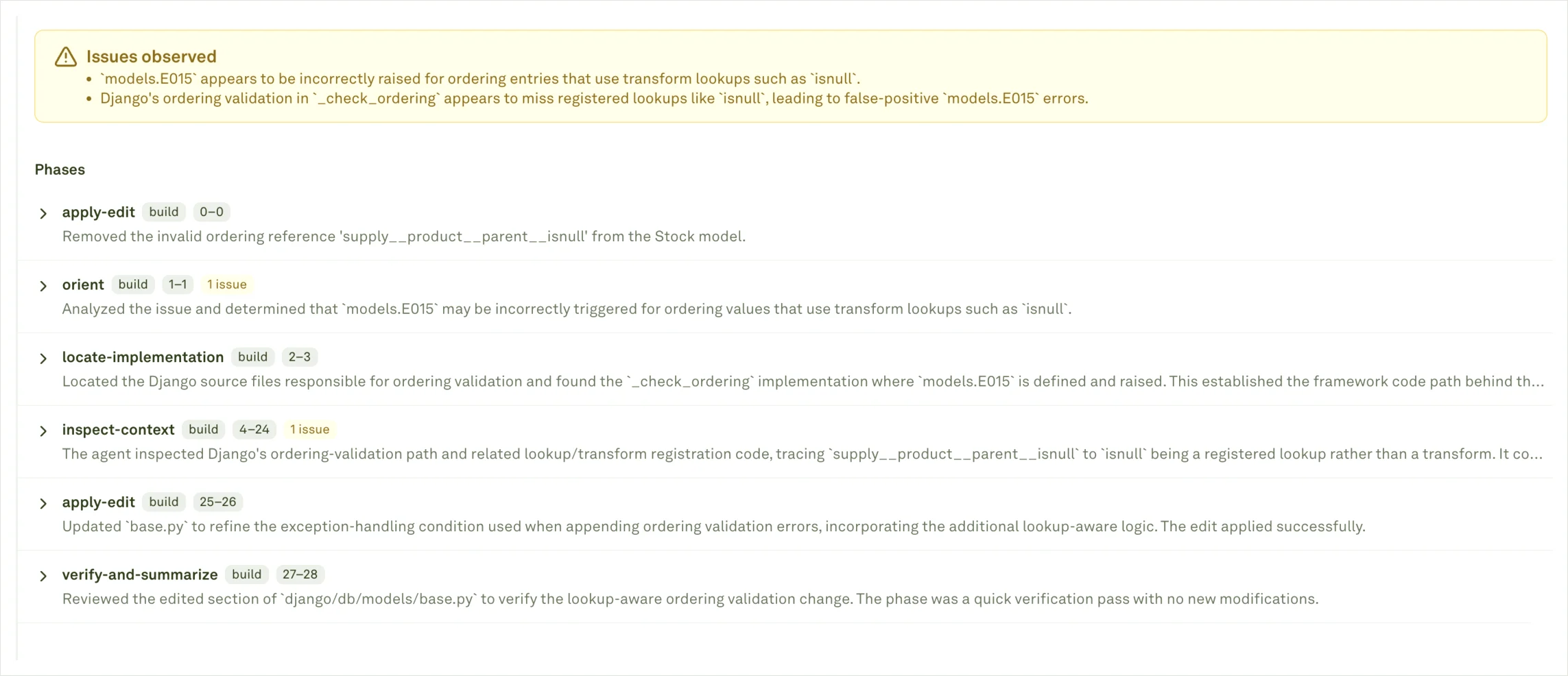 A useful trajectory is easier to understand when you read it as phases instead of isolated events.
| Phase | What to inspect |
| ----------------------- | ------------------------------------------------------------------------------ |
| **Planning** | Did the agent understand the task, constraints, and likely fix path? |
| **Search / inspection** | Did it look in the right files, tools, documents, or traces? |
| **Action** | What edits, tool calls, retrieval steps, or backend operations did it perform? |
| **Verification** | Did it run tests, checks, tool validation, or another meaningful confirmation? |
| **Recovery** | Did it adapt after failures, or repeat the same bad step? |
| **Handoff** | Did the final answer accurately describe what happened and what remains? |
Not every project will expose every phase in the same way. The important part is that the trajectory should make the task path understandable enough for a reviewer to choose the right fix layer.
In the phase list, look for the point where the task changed direction: a failed command, a wrong file search, an edit without verification, a repeated tool call, or a final summary that skips an unresolved issue. Those transition points usually tell you whether the next fix belongs in the prompt, tool policy, runtime setup, repository context, or evaluator coverage.
## Move from story to source evidence
Trajectories summarize the journey; source spans prove the details. After reading a trajectory, open the linked spans for the exact model call, tool call, command, retrieval step, or backend operation that matters.
This keeps the review grounded. A Behavior may look like a prompt problem from the title, but the trajectory might show a broken tool, missing context, runtime setup issue, bad retrieval result, or incomplete logging.
## When trajectory evidence is weak
If a trajectory feels vague or incomplete, improve the logging before relying on it for a release decision.
Common gaps include:
* Missing stable task, session, or run identifiers for multi-step work.
* Generic trace or span names.
* Missing outcome/status.
* Missing agent identity or workflow metadata.
* Missing spans for tool calls, commands, retrieval, edits, or verification.
* Too little traffic for Adaline to compare examples.
Fixing those gaps makes future Behaviors easier to read and makes Improve cycles more useful.
## Choose the next action
| What the trajectory shows | Good next action |
| ---------------------------------------------------------------- | -------------------------------------------------------------------------------------- |
| The issue is prompt-addressable. | Start an [Improve cycle](/improve/trigger-a-cycle) if the prompt is stored in Adaline. |
| The agent skipped verification. | Add verification instructions, evaluator coverage, or command/tool policy. |
| The problem is tool, retrieval, backend, or environment-related. | Fix that layer before changing prompts. |
| The trajectory is a useful healthy run. | Preserve it with dataset examples or evaluator coverage. |
| The evidence is unclear. | Improve logging and wait for more examples before making a release decision. |
Understand coding-agent task patterns and setup requirements.
Return to the catalog and detail review workflow.
Send the traces, spans, and metadata that make trajectories useful.
Turn prompt-addressable patterns into reviewed prompt candidates.
A useful trajectory is easier to understand when you read it as phases instead of isolated events.
| Phase | What to inspect |
| ----------------------- | ------------------------------------------------------------------------------ |
| **Planning** | Did the agent understand the task, constraints, and likely fix path? |
| **Search / inspection** | Did it look in the right files, tools, documents, or traces? |
| **Action** | What edits, tool calls, retrieval steps, or backend operations did it perform? |
| **Verification** | Did it run tests, checks, tool validation, or another meaningful confirmation? |
| **Recovery** | Did it adapt after failures, or repeat the same bad step? |
| **Handoff** | Did the final answer accurately describe what happened and what remains? |
Not every project will expose every phase in the same way. The important part is that the trajectory should make the task path understandable enough for a reviewer to choose the right fix layer.
In the phase list, look for the point where the task changed direction: a failed command, a wrong file search, an edit without verification, a repeated tool call, or a final summary that skips an unresolved issue. Those transition points usually tell you whether the next fix belongs in the prompt, tool policy, runtime setup, repository context, or evaluator coverage.
## Move from story to source evidence
Trajectories summarize the journey; source spans prove the details. After reading a trajectory, open the linked spans for the exact model call, tool call, command, retrieval step, or backend operation that matters.
This keeps the review grounded. A Behavior may look like a prompt problem from the title, but the trajectory might show a broken tool, missing context, runtime setup issue, bad retrieval result, or incomplete logging.
## When trajectory evidence is weak
If a trajectory feels vague or incomplete, improve the logging before relying on it for a release decision.
Common gaps include:
* Missing stable task, session, or run identifiers for multi-step work.
* Generic trace or span names.
* Missing outcome/status.
* Missing agent identity or workflow metadata.
* Missing spans for tool calls, commands, retrieval, edits, or verification.
* Too little traffic for Adaline to compare examples.
Fixing those gaps makes future Behaviors easier to read and makes Improve cycles more useful.
## Choose the next action
| What the trajectory shows | Good next action |
| ---------------------------------------------------------------- | -------------------------------------------------------------------------------------- |
| The issue is prompt-addressable. | Start an [Improve cycle](/improve/trigger-a-cycle) if the prompt is stored in Adaline. |
| The agent skipped verification. | Add verification instructions, evaluator coverage, or command/tool policy. |
| The problem is tool, retrieval, backend, or environment-related. | Fix that layer before changing prompts. |
| The trajectory is a useful healthy run. | Preserve it with dataset examples or evaluator coverage. |
| The evidence is unclear. | Improve logging and wait for more examples before making a release decision. |
Understand coding-agent task patterns and setup requirements.
Return to the catalog and detail review workflow.
Send the traces, spans, and metadata that make trajectories useful.
Turn prompt-addressable patterns into reviewed prompt candidates.